How to coach passing in youth soccer
In a good passing drill, the reason to pass comes from the game, and the reps pile up on their own. The simplest version is a pattern where the ball never stops and players learn to open their body before it arrives. Once that flows, a defender in the middle forces the receiver to scan and choose. Under-10s need short distances and plenty of touches. By U12 you can stretch the area and ask for one-touch play and switches of play. Coach the first touch as part of the pass, because a receiver who controls the ball into space has made the next pass easier.

Line passing 1/3
Four players in a straight line, 5–10 metres between each position, with each spot marked. The top player starts with the ball. The two middle players open up from their marks to the side of the line, to different sides, and receive the ball in an open body position. The ball travels through the line: the top player passes to the first middle player, who passes to the second middle player, who passes to the bottom player. At the end, the middle players return to their marks and the same pattern comes back the other way, but now both open up to the opposite side. Start with two touches and then move to one touch as the pattern progresses.

4v1 Rondo
Four players keep the ball in the corners of a square, with one defender in the middle trying to win it. When the defender wins the ball, they swap places with the player who lost possession.

Pallohippa
Moni pelaaja syöttää ja jää sitten katsomaan palloa. Hipassa se kostautuu heti: pallon on lähdettävä ennen kuin hippa ehtii, ja sen voi syöttää vain kaverille, joka on liikkunut vapaaseen tilaan. Animaatio näyttää ensin tavallisen virheen ja sitten oikean tavan. Alue noin 23 × 23 m. Neljä joukkuetta, joista kolmella on pallo. Neljäs joukkue on hippoja. Hippa saa koskea vain pelaajaa, jolla on pallo. Joukkueet auttavat toisiaan syöttämällä ja liikkumalla, ettei kukaan jää kiinni. Kiinni jääneen vapauttaa joukkuetoverin ylävitonen. Kuvassa joukkueet ovat pareja, ja hippoja on kaksi. Helpompi: pelataan käsin heittämällä ja kiinniottamalla, ja hippoja on vähemmän. Vaikeampi: lisää hippoja.
From patterns to games
Most passing drills on this page start as a pattern without defenders. In three-player warm-up passing, the middle player moves to meet the ball, plays it straight back, turns and does the same on the other side. Line passing comes in three steps: in the first, the two middle players move off the line to receive in an open body shape, and in the third, long passes go past the middle player. Start with two touches and move to one once the pattern flows. Cross passing with rotation adds a directional first touch: the middle player checks over the shoulder and passes to a new cone, not back to where the ball came from. The 4v1 and 5v2 rondos put defenders in the way, and the four corners pass-and-move game and ball tag turn passing and moving into a game. In the four corners game, a point comes from a pass to a player who has run into a corner square, and a joker always plays for the team on the ball. The switch of play, the through ball into space and passing for an overlap work on long passes and passes into space or into a teammate's run. In the switch of play, the pitch is split into three vertical zones, and a long pass moves play to the opposite zone.

Three-player warm-up passing 1/3
Two players stand still 15–20 metres apart, each with a ball. The third works between them without a ball. The middle player starts by moving to receive on the right. The right player passes, and the middle player returns the ball straight back. Then he turns, runs to the other side and repeats the same on the left. Neither ball crosses the central area; each wide player keeps possession of their own side. The middle player does not stand still after the return; he turns immediately. Change the middle player about every minute. First rounds with two touches. When the rhythm is found, return with one touch.

Cross passing with position change
Set up five cones in a cross shape: one in the middle, four around it 5–10 metres away. One player at each cone. The ball starts from an outer cone to the middle. The middle player takes a directional first touch and passes with that to a new outer cone, not back to the cone the ball came from. Then the passer and the middle player swap roles: the passer runs into the middle, and the middle player takes the free outer spot. So in the middle there is a different player each round. Adjust the distances to the players’ age and ability level.

5v2 Rondo
Five outfield players keep the ball, while two defenders in the middle try to win it or cut out the pass. When a defender wins the ball, the last passer and the player before them swap into the middle. Touch restriction (1–2) depending on the level.
Questions for the passer and the receiver
Is the pass good enough that your teammate can play it one-touch? Can you see the next target before the ball arrives, and which way will your first touch go? When do you move away from your marker, before the pass or after it? In the games, the question becomes where you go once you've passed. In ball tag, the ball can only go to a teammate who has moved into space, and in the four corners game nobody scores by standing still. With the longer passes there's one more: do you play to your teammate's feet or into the space in front of them? Line passing 3/3 also asks how the weight of the pass changes between a short return pass and a long pass beyond the middle player, and the Y passing pattern asks whether you stay still after the pass. The technique cues are the same from drill to drill: the non-kicking foot behind the ball, contact through the middle of the ball with the inside of the foot, and a follow-through in the direction of the pass.

Kulmaruutupeli: syötä ja liiku
Moni pelaaja syöttää ja jää sitten katsomaan palloa. Tässä pelissä seisomalla ei saa pisteitä. Syöttäjän pitää liikkua uuteen tilaan, ja ruutuun ehtii vain ajoittamalla juoksun. Animaatio näyttää ensin tavallisen virheen ja sitten oikean tavan. Alue 20 × 25 m, jokaisessa kulmassa 5 × 5 m:n ruutu. Kaksi joukkuetta ja jokeri, joka pelaa aina pallollisen joukkueen mukana. Kuvassa on 2v2 ja jokeri, joten hyökkääjillä on 3v2-ylivoima. Isommalla porukalla vaikka 4v4 ja jokeri. Hyökkäävä joukkue saa pisteen syöttämällä ruutuun juosseelle pelaajalle. Jokeri ei tee pisteitä. Ruudussa ei saa odottaa. Sinne lähdetään vasta, kun syöttö on tulossa, ja pisteen jälkeen pallo tuodaan heti ulos. Kun puolustajat voittavat pallon, roolit vaihtuvat ja jokeri vaihtaa puolta.

Passing in a line 3/3
Four players in a line 10–15 metres apart, a marker at each position. Numbers from top to bottom: two, three, four, five. Two starts with the ball. Going down: two passes to three, who returns it straight back. Two plays a long pass past three to four, four guides the ball to three, and three plays a long pass past four to five. Going up, the same as a mirror image: five passes to four, gets the return pass and plays a long pass past four to three. Three guides it to four, four plays a long pass back to two, and the sequence starts again. Three and four move away from the line to opposite sides just before the pass is played. This allows the long pass to go past the previous player. After their own pass, return to the line. Short passes with two touches, long passes firm along the ground. Once the pattern flows, tighten the short passes to one-touch.

Y passing pattern
Players set up in a Y-shaped formation at three points. The ball is played through the body into a branch. The receiver plays a one-two (or a through pass) to the next point and follows the ball. The pattern is repeated into both branches, alternating each time.
Passing drills by age
Every drill on this page carries an age marking. Ball tag is marked from U8. From U9 come the 4v1 rondo, first touch and passing on the move, and passing for an overlap. From U10 come all three steps of line passing, the three-player warm-up passing series, the Y passing pattern, cross passing with rotation, the four corners pass-and-move game and the 5v2 rondo. From U11 come the through ball into space and the switch of play. Set the distances for your group, as the cross passing drill advises.

Passing and first touch on the move
A drill with three players: one player is in the middle of a square marked with cones, and the other two are positioned on either side at a passing distance. The drill starts with a pass. The player in the centre tries to guide the ball with their first touch to outside the square, and then immediately passes to the third player. After the pass, transition into the centre and the central player fills the empty space.
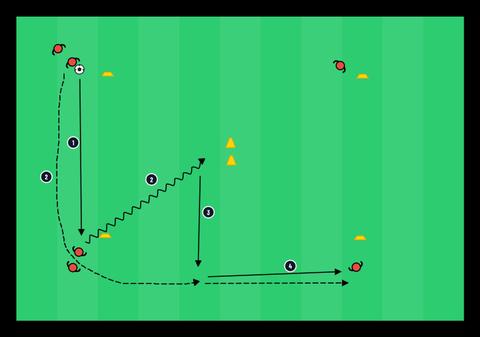
Passing into an overrun
A player passes the ball and then makes an overrun behind a second player. The receiver dribbles the ball near the cones and passes to the player making the overrun, who then passes on to the third line. The drill progresses in four phases: 1) initial pass, 2) dribbling to the cones, 3) pass into the overrun, and 4) pass to the third line.

Through pass into space
The passer plays the ball in midfield. The receiver makes a run towards the ball and quickly breaks away behind the defender’s back. The passer plays a through pass behind the defensive line into space. The receiver runs onto the ball, then finishes into the goal.

Ball tag (incorrect, video only)
Many players make a pass and then just watch the ball. In tag, that is punished straight away: the ball must be moved on before the tagger gets there, and it can only be passed to a teammate who has moved into free space. Area approx. 23 × 23 m. Four teams, three of which have a ball. The fourth team are the taggers. A tagger may only touch the player on the ball. The teams help each other by passing and moving so that nobody gets caught. A caught player is freed by a teammate giving them a high five. In the picture, the teams are in pairs, and there are two taggers. Easier: play with hands by throwing and catching, and have fewer taggers. Harder: add more taggers.

Echauffement du lundi 12 octobre 2026
DESCRIPTION : Le joueur au chapeau rouge transmet alternativement le ballon à droite au centre sur le joueurs orange et à gauche au joueur bleu. Le joueur bleu effectue des allers-retours rapides devant les coupelles rouges. À chaque déplacement, il reçoit le ballon et le remet en une touche avant de repartir immédiatement dans la direction opposée. OBJECTIF : Développer la capacité à répéter des efforts intenses tout en conservant une bonne qualité technique.

Line Passing 2/3
Four players in one line, with 5–10 metres between them, each position marked. The ball always goes past the nearest player. The top player plays a long ball past the first middle player to the second middle player, who has moved out to the side. This player lays the ball off one-touch back to the player who was bypassed, who has meanwhile moved out to the other side of the line, and the bypassed player plays a long ball to the bottom player, again past the middle player. At the far end, the middle players return to their markers and the same pattern comes back the other way, moving out to the opposite sides. The bypassed player starts moving before the long pass is played.

Three-player warm-up passing 3/3
Two players stand still, 15–20 metres apart, with markers in front of their feet. The third works between them. One ball. The right-hand player passes a short pass to the middle player, who has come towards it, and the middle player returns the ball back. Immediately after, the same player plays a long pass to the far end. The middle player does not stay in the passing lane; they move to the side and start running to the other side at the same time. There it repeats: short pass in to the middle, return, then a long pass back. So in the rotation there are three passes: short pass in, return, and then the long switch. The middle player’s job is to arrive before the ball and get out of the way before the long pass. Change the middle player about every minute.

Three-player warm-up passing 2/3
Two players stand still, 15–20 metres apart, with markers in front of their feet. The third player works between them. One ball. The left player passes to the middle player, who has moved towards his side. The middle player takes their first touch into the opposite direction and passes there. The same continues alternately. Demand direction from the first touch: the ball must go where it is going to. Change the middle player about every minute.

Passing, dribbling and shooting from a vertical pass
The player at the front of the line makes a movement to either side of the cones and asks for the pass. The first player in the queue plays the pass, and the receiver makes a short dribble towards the player positioned in the diagonal angle and plays him a vertical pass. The receiver of the pass tries to “avoid offside” (the cones represent the deepest defenders) and to finish directly from the pass.

Switch of play
The pitch is divided into three vertical zones. The attacking team plays the ball in one zone and tries to switch play with a long pass into the opposite zone. The defending team tries to intercept the switch of play.
Diamond pass
Four players set up in a diamond shape. The ball circulates clockwise: - Bottom point passes to the side point - Side point passes to the top point - Top point passes to the other side point - Back to the bottom point The passer follows the ball to the next point.

One-two passing in pairs
Player A passes to Player B and immediately moves to the side or forward. B returns the ball with one-touch into A’s running direction. A controls and repeats. Rotate every 2–3 minutes.

Passing triangle
Three players form a triangle. The ball travels clockwise or anticlockwise. After the pass, the player follows the ball and runs to the next cone.

Gate passing competition in pairs
On the pitch, set up several small gates (two cones 2 metres apart). - The pairs pass the ball through the gates and count their successful passes. - The gate must be changed after every successful attempt. - The pair that passes through the most gates wins.

Square passing with directional first touch
Players are placed at four cones in a square. The ball is moved clockwise: the player plays a pass to the next cone and runs after the pass. The receiver takes the ball with a directional first touch.

Passing circle
Players on the sides have balls. The players in the middle move and ask for the ball from the sides, then return it first after control (aim: 2nd touch) and then with the first touch as a wall pass. The third variation is a throw from the wide player: the player in the middle controls and returns the ball. The central players always go through the middle of the area after each return before asking for the next pass.

Finishing in three areas
The red player starts the move, feints past the cone defender and shoots at goal. The blue player immediately passes to the red player, and the red player plays a one-two (wall pass), from which the blue player finishes. After that, the yellow player passes to blue, who plays the one-two to the end of the pitch. The yellow then crosses from the end line, and both the blue and red players take part in the finishing.

exercice de coordination et technique
DESCRIPTION DE L’EXERCICE Le joueur bleu démarre de sa file et effectue un slalom entre les piquets jaunes. Il contourne ensuite le cône rouge avant d’effectuer une passe au joueur bleu positionné dans le mini-but. Après sa passe, il poursuit sa course en direction de l’échelle de coordination ou des cerceaux. Il réalise un travail de coordination, d’appuis et de proprioception avant de revenir dans sa file de départ. Les joueurs enchaînent les passages en alternant les différents parcours. Materiels 6 cerceaux 2 échelles 1 cone 1 ballon par Pers 12 piquet ou cones `

5v5 goal dribbling game
A 5v5 game to practise opening play with dribbling. - When the ball goes over the end line, the defending team starts by dribbling from anywhere in their own penalty area. - The opponent waits 5.5 metres from the ball. - The dribbler can take the ball forward themselves or pass to a free player. In the diagram, the pressing player goes towards the goalkeeper, so the goalkeeper passes left to the free player. - The free player carries along the flank and then passes to the attacker, who shoots. Scoring: - If an attack that starts from the goal dribble ends in a goal, it’s worth 2 points. - Any other goal is worth 1 point. - Play short spells and change teams often. According to the Finnish Football Association rules: for 8- and 9-year-olds, the 5v5 game is started with dribbling. For 7-year-olds and younger, the opponent drops back to the half-way line during the goal dribble and defends only once the game has been opened.

Opening from a goal kick 3v2
We practise the goal kick in an 8v8 game, where the game is opened with short passing. The goalkeeper and two centre-backs play against two pressers. The centre-backs spread out to the wide areas at the corners of the penalty area, and the goalkeeper kicks the ball from the ground to the one who is free. The blue team scores a point when it passes or dribbles the ball through the gate on the side, about 24 metres from the goal line. The reds try to win the ball and score. When a presser closes down a centre-back, the centre-back returns the ball to the goalkeeper, and the goalkeeper switches play to the other side. Start without pressers, then add one, and finally two. For 10–11-year-old 8v8 games, the goal kick can be taken from the ground from anywhere in the penalty area, and the opponent does not have to retreat: it’s enough that they are 5.5 metres from the ball. The pressers can therefore stand as close in the drill as they would in the match.

End-zone game, target players in the end zones
Six players in three pairs in a clear area. No goals. - One pair are target players. - One pair in each end zone, and they move only along their own end line. - The other two pairs play 2v2 in the middle. A point is scored when the ball is dribbled from one end zone to the other, i.e. from one target player to the other. After a successful pass, the same team continues with the ball in the opposite direction. The defending pair tries to close the passing lane to the target player and win the ball. After winning the ball, the pair that wins it can attack either end zone, but the point always requires the full journey: the ball must be passed from one target player to the other. In practice, the winning pair starts from the nearest end zone. - 3 minutes at a time, then pairs swap positions.

Drop to the second wave
From the centre, pass to the wide player (laituri), who dribbles onto the byline. The attacker (kärki) draws the defender with him towards the near post. When the defending team has dropped towards the goal, the midfield player arrives late at the edge of the penalty area through the gate. The wide player drops the ball behind him and the arriving player shoots directly from the pass. At the goal: goalkeeper. Start alternately from both sides.

Switch of play and cross
Four players in a diamond: both flanks, one in the middle at the front and one in the middle at the back. The wide player starts dribbling towards the goal. The deepest player calls, which stops the dribble and the ball is played back. The deepest player switches play directly to the opposite flank, who goes forward and delivers a cross. The others arrive in a staggered way in front of goal to finish. Start alternately from each flank. Instead of a cross, a sharp low pass from the flank is also allowed.