What rondo drills train
A rondo is a possession game in a small area: the players on the outside keep the ball, and one or more defenders in the middle try to win it. Rondo drills train quick, accurate passes with the right weight, a first touch away from the defender who is pressing, and the habit of knowing where that defender is before the ball arrives. The small area packs a lot of touches and decisions into a few minutes, and the rules are simple enough that you can start straight away. In most of the rondos on this page, when the defenders win the ball, the players who lost it go into the middle and play goes on.

4v1 Rondo
Four players keep the ball in the corners of a square, with one defender in the middle trying to win it. When the defender wins the ball, they swap places with the player who lost possession.
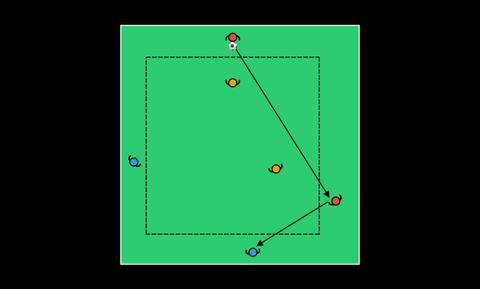
4v2 rondo
Mark out a square area and create three pairs of two players. Two pairs stay on the outside along the edges, so there are four passers (one on each side). One pair works inside the area, winning the ball. The outside pairs keep the ball moving from side to side. The defenders split the work: one player presses the player on the ball, while the other closes off the next passing lane. When winning the ball is successful, the pairs swap roles and the game continues immediately without a new start. Adjust the size of the square to the level. A smaller square shortens the passing distances and forces quicker first touch.

5v2 Rondo
Five outfield players keep the ball, while two defenders in the middle try to win it or cut out the pass. When a defender wins the ball, the last passer and the player before them swap into the middle. Touch restriction (1–2) depending on the level.
The rondos on this page
First up is the single-defender rondo. In the 4v1 rondo, four players, one on each side of a square, keep the ball away from one defender and can move along their own side. A defender who wins it swaps places with the player who lost it. In the 4v2 rondo there's a second defender, and the two share the work: one presses the player on the ball, the other blocks the next passing lane. When the ball is won, the pairs swap places and play goes on at once without a restart. A smaller square shortens the passes and forces a quicker first touch. In the 5v2 rondo, five outside players face two defenders with a limit of one or two touches, depending on the level. In the rondo with jokers, two jokers always play for the team on the ball, so the outside players have to choose between the joker and another outside player. The jokers move along the edges of the area on unlimited touches, while the outside players have one or two. The 4v2 pressing rondo puts the defenders first. They press by cutting off passing lanes, and nobody chases the ball. The last two spread it over zones. In the three-zone rondo, an area of 30 × 15 metres is split into three zones. The teams in the end zones try to pass across the middle, the middle team sends two players to win the ball, and a point comes when the ball travels from end to end. When the ball is won or goes out, the team that lost it moves into the middle. In the zonal rondo, the team on the ball starts in the middle zone, plays out to a wide zone and switches through the middle to the other side.

Numerical superiority possession game with jokers
Possession game (e.g. 4v2) with two jokers, who always play on the side of the player on the ball. The jokers move along the edges of the area and offer extra passing options. 1-2 touch limit for the outside players, jokers on free touches. The defenders try to win the ball — the player who made the last pass goes into the middle.

Pressing drill (4v2)
The outside players keep possession with one-touch or two touches, while 2 defenders in the middle try to win the ball or intercept a pass. When a defender gets the ball or forces it outside the area, the player who made the last pass swaps into the middle.

Three-zone possession drill (basic)
Three teams, one per zone (30×15 m divided into three 10×15 m areas). The teams in the end zones keep possession and try to pass to the other end zone. The middle team sends 2 players to win the ball in the end zone and 1 stays in the middle to intercept passes between the zones. When the ball is won or goes out, the team that lost possession moves into the middle. A point is scored when the ball is played successfully from end to end.
Coaching points and key questions
Three of the rondos ask what you see before you receive. The 4v2 rondo asks where you look before the ball comes to you, and the 5v2 rondo which way you turn your body before it arrives. The 4v1 rondo asks where you move on your side when a teammate gets the ball, and how you can tell that a pass through the middle won't get past the defender. In the 4v1 rondo the first touch goes away from the defender, in the 4v2 rondo towards the side where the next pass goes. In the 4v2 rondo, the 5v2 rondo, the pressing rondo and the three-zone rondo, the defenders are asked who presses and who covers. The pressing rondo also asks whether they talk to each other on the pitch. The 5v2 rondo asks the outside players how they recognise the moment to pass between the defenders, and the zonal rondo asks how many touches you need and why. The three-zone rondo brings in the transition too: the team that loses the ball moves straight into the middle to defend.

Zonal rondo
Three zones next to each other (narrow-wide-narrow). The team in possession starts in the middle zone and tries to play the ball to the wide zone. The defenders try to stop the ball being played wide. After a successful pass wide, the ball is played back into the middle and switched to the other side.
Rondos by age
The 4v1 rondo and the rondo with jokers are marked from U9, the 4v2 rondo, the 5v2 rondo, the three-zone rondo and the zonal rondo from U10, and the 4v2 pressing rondo from U11. With a single defender, the 4v1 rondo is the simplest drill on the list. Jokers make keeping the ball easier, because they always create a numerical advantage. Still, the easiest dial to turn is the size of the area: a bigger square gives more time, a smaller one less.