Football drills for 10 year olds
This page collects the drills marked for U9 and U10, grouped by skill: passing and first touch, dribbling and 1v1, finishing, defending, small-sided games, and possession and transitions. If you're looking for passing drills for 10 year olds, start with the first group. Above the drills are three ready-made one-hour sessions built from the drills on this page: one for passing, one for 1v1 and finishing, and one for defending.
Three ready-made sessions
The ready-made sessions are built the same way: each starts with a 10-minute drill, continues with two 15-minute drills and ends with a 20-minute game. The passing session has the passing diamond, cross passing with rotation, the 4v2 rondo and the end zone game with target players in the end zones. The 1v1 and finishing session has the two-phase 1v1 to goal, cutback finishing, the wide 2v1 and cross, and the 3v3 line game. The defending session has 2v2 with a cover line, 2v2 pressing and penetration, 2v2 recovery defending and the end zone game with changing direction. The table shows how long each drill runs, and each drill's name takes you to its own page.
Passing drills for 10 year olds
In these passing drills the first touch matters as much as the pass. In square passing with directional first touch, the ball goes round a square and the receiver directs the first touch towards the next pass. The passing diamond also has a one-two and a long pass played first time. In first touch and passing on the move, the middle player takes the ball out of the square with the first touch and passes straight on to the third player. Square passing asks whether you are open towards the next direction before the ball arrives and whether you move as soon as you have passed, and the passing diamond whether you are already moving when the ball is played. The four corners pass-and-move game and the end zone game with target players in the end zones practise moving after the pass and receiving in an open body shape in a game.
1v1, finishing and defending
In the two-phase 1v1 to goal, the attacker takes the first touch out of the square to the side where the defender isn't, then meets a second defender. The defender is asked how they recognise that it is their turn to go, and how they slow down before reaching the attacker. In the 1v1 challenges three-zone channel, there are three defenders to beat in a row, and the questions are whether you vary the feint and keep your speed. Cutback finishing and the wide 2v1 and cross end in a cut-back or a cross and a finish, and in 3v2 finishing the player decides whether to pass or shoot. The defending drills are built on how a pair shares the work. In 2v2 with a cover line and 2v2 pressing and penetration, the presser closes down while the ball travels, slows to arm's length side-on, and the covering player stands diagonally behind on the inside. In 2v2 recovery defending, the pair first recovers along the inside line to get between the ball and the goal, and when the ball goes wide, the nearer defender presses and the other drops inside to cover.
Small-sided games and rondos
In the small-sided games, players have to use the same skills in the middle of a game. In the 3v3 line game, a goal counts when the ball is controlled behind the opponents' end line, which teaches attacking and defending in depth. In the end zone game with changing direction, the coach turns the direction of attack mid-game, and the space is suddenly behind the defenders. The rondos on this page are the 4v1, 4v2 and 5v2 rondos, the three-zone rondo, the zonal rondo and the rondo with jokers, and in the counter-pressing game the team that loses the ball has five seconds to win it back. On the board you can change the area and the numbers to suit your team.
Ready-made U10 sessions
Three one-hour sessions you can run as they are. Open one in TacticsBoard and tweak it for your team.
U10 session: passing and first touch
U10 session: 1v1 and finishing
U10 session: defending and transitions
Passing and first touch

Square passing with directional first touch
Players are placed at four cones in a square. The ball is moved clockwise: the player plays a pass to the next cone and runs after the pass. The receiver takes the ball with a directional first touch.

Kulmaruutupeli: syötä ja liiku
Moni pelaaja syöttää ja jää sitten katsomaan palloa. Tässä pelissä seisomalla ei saa pisteitä. Syöttäjän pitää liikkua uuteen tilaan, ja ruutuun ehtii vain ajoittamalla juoksun. Animaatio näyttää ensin tavallisen virheen ja sitten oikean tavan. Alue 20 × 25 m, jokaisessa kulmassa 5 × 5 m:n ruutu. Kaksi joukkuetta ja jokeri, joka pelaa aina pallollisen joukkueen mukana. Kuvassa on 2v2 ja jokeri, joten hyökkääjillä on 3v2-ylivoima. Isommalla porukalla vaikka 4v4 ja jokeri. Hyökkäävä joukkue saa pisteen syöttämällä ruutuun juosseelle pelaajalle. Jokeri ei tee pisteitä. Ruudussa ei saa odottaa. Sinne lähdetään vasta, kun syöttö on tulossa, ja pisteen jälkeen pallo tuodaan heti ulos. Kun puolustajat voittavat pallon, roolit vaihtuvat ja jokeri vaihtaa puolta.

Opening from a goal kick 3v2
We practise the goal kick in an 8v8 game, where the game is opened with short passing. The goalkeeper and two centre-backs play against two pressers. The centre-backs spread out to the wide areas at the corners of the penalty area, and the goalkeeper kicks the ball from the ground to the one who is free. The blue team scores a point when it passes or dribbles the ball through the gate on the side, about 24 metres from the goal line. The reds try to win the ball and score. When a presser closes down a centre-back, the centre-back returns the ball to the goalkeeper, and the goalkeeper switches play to the other side. Start without pressers, then add one, and finally two. For 10–11-year-old 8v8 games, the goal kick can be taken from the ground from anywhere in the penalty area, and the opponent does not have to retreat: it’s enough that they are 5.5 metres from the ball. The pressers can therefore stand as close in the drill as they would in the match.

Passing and first touch on the move
A drill with three players: one player is in the middle of a square marked with cones, and the other two are positioned on either side at a passing distance. The drill starts with a pass. The player in the centre tries to guide the ball with their first touch to outside the square, and then immediately passes to the third player. After the pass, transition into the centre and the central player fills the empty space.

Passing diamond
A diamond is made out of cones. On the first cone there are two players, and on the other cones there is one player each. Player 1 plays the first pass to player 2, who then returns a wall pass. Player 1 tries to play a long pass to player 3 with the first touch. After each set of passes, rotate to the next passing direction.
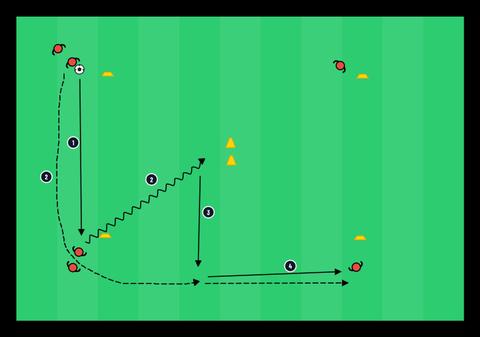
Passing into an overrun
A player passes the ball and then makes an overrun behind a second player. The receiver dribbles the ball near the cones and passes to the player making the overrun, who then passes on to the third line. The drill progresses in four phases: 1) initial pass, 2) dribbling to the cones, 3) pass into the overrun, and 4) pass to the third line.

Cross passing with position change
Set up five cones in a cross shape: one in the middle, four around it 5–10 metres away. One player at each cone. The ball starts from an outer cone to the middle. The middle player takes a directional first touch and passes with that to a new outer cone, not back to the cone the ball came from. Then the passer and the middle player swap roles: the passer runs into the middle, and the middle player takes the free outer spot. So in the middle there is a different player each round. Adjust the distances to the players’ age and ability level.

Passing in a line 3/3
Four players in a line 10–15 metres apart, a marker at each position. Numbers from top to bottom: two, three, four, five. Two starts with the ball. Going down: two passes to three, who returns it straight back. Two plays a long pass past three to four, four guides the ball to three, and three plays a long pass past four to five. Going up, the same as a mirror image: five passes to four, gets the return pass and plays a long pass past four to three. Three guides it to four, four plays a long pass back to two, and the sequence starts again. Three and four move away from the line to opposite sides just before the pass is played. This allows the long pass to go past the previous player. After their own pass, return to the line. Short passes with two touches, long passes firm along the ground. Once the pattern flows, tighten the short passes to one-touch.

3v2 breaking out from the wide areas
The attacking trio plays the ball and looks for the free side to attack from — defenders switch sides and cover the centre. When the ball is played to attack from the wide area, the two unmarked attackers look for a goal-scoring opportunity directly from the pass.

Passing square with a midfielder
Effective passing and control

Passing square with diagonal runs
Players run diagonally through the square, and whenever you have played a pass from the middle to the runner, you go next.

Finishing from a one-two
The blue player makes the first move away from the defender, and the first player in the line plays the pass into the movement. Blue takes the ball under control and immediately continues with a pass to the yellow player. Yellow plays a one-two into the defender’s back and blue looks to shoot straight from the pass into goal. The defender follows but does not intercept the passes. Rotation: from the attacker to give the one-two, and the defender goes forward. The one-two giver goes to the back of the line, and the player who played the first pass goes to defend.

Passing, dribbling and shooting from a vertical pass
The player at the front of the line makes a movement to either side of the cones and asks for the pass. The first player in the queue plays the pass, and the receiver makes a short dribble towards the player positioned in the diagonal angle and plays him a vertical pass. The receiver of the pass tries to “avoid offside” (the cones represent the deepest defenders) and to finish directly from the pass.

Control from the air
In pairs: the passer throws the ball in a lofted pass to the receiver, who takes the control with the thigh, chest or instep and plays the ball back along the ground with two touches. Three stations: thigh and to the ground, chest and to the ground, instep and to the ground.

3v2+1 numerical superiority attack
Three attackers play against two defenders. One additional player waits on the flank and joins in when the ball crosses a certain line. The attackers aim for quick finishing before the defence can get organised. If the defenders win the ball, they play a counter-attack.

Combination play with one-twos
Players practise different one-two patterns on the move: a simple one-two or a triangular passing pattern. Each pattern ends with a shooting opportunity. First without defenders, then with passive defenders and finally with active defenders.

Control and turning
The central player moves towards the passer, makes the control with the first touch and turns 180 degrees. Passes with the second or third touch in the opposite direction to the target player.
Diamond pass
Four players set up in a diamond shape. The ball circulates clockwise: - Bottom point passes to the side point - Side point passes to the top point - Top point passes to the other side point - Back to the bottom point The passer follows the ball to the next point.
Control under pressure (Keep-away)
The outside players keep possession with a 1–2 touch limit, while 1–2 defenders try to win the ball from the middle. The receiver takes the ball under control away from pressure and plays forward quickly.
Control of a lofted ball
In pairs: the passer throws the ball in a lofted pass to the receiver, who controls it with the thigh, chest or instep and plays the ball back along the ground in two touches. Three stations: thigh to ground, chest to ground, instep to ground.
Dribbling and 1v1

Kaksivaiheinen 1v1 maalille
Kaksivaiheinen 1v1., lähtee käyntiin hyökkääjän liikkeestä. Hyökkääjä pyytää syötän tötsillä rajattuun neliöön (1. puolustaja seuraa), jossa pyrkii siirtämään pallon ensimmäisellä kosketuksellla jommalle kummalle puolelle. Kun pallo on neliön ulkopuolella, on toisen puolustajan vuoro puolustaa. Nyt perinteinen 1v1, jossa hyökkääjä pyrkii maalintekoon. Roolien kierto: hyökkääjä jonon perälle, 1. puolustaja hyökkäämään ja toisesta puolustajasta ensimmäinen puolustaja. Syöttäjä toiseksi puolustajaksi.

2v2 to four goals
2v2 in a small area with four cone goals on the edges of the pitch. A goal is scored by dribbling the ball through any pair of cones. Because there are goals in every direction, the player on the ball must constantly turn and protect the ball to find an open goal.

Turn test
The attacker starts with the ball at one end of the channel, while the defender stands in the middle of the channel facing the attacker. The aim is to beat the defender with a feint or a change of direction and score.

1v1 challenges — three-zone channel
The attacker starts with the ball from the edge of the first zone. In each zone, a different defender is waiting, who must be beaten to progress. After the final beat an opponent, a shot at goal.

1v1 back to goal — turn and shoot
An attacker stands back to goal in the middle of the area, with a defender behind him. The passer plays the ball to the attacker, who tries to turn and finish. The defender looks to prevent the turn. The attacker’s task can be made easier by allowing the defender to keep his hands behind his back.

1v1 channel — passing situation
The attacker starts with the ball at one end of the channel, while the defender stands in the middle of the channel facing the attacker. The aim is to beat the defender with a feint or a change of direction and score.

Through-dribbling route
A player starts dribbling towards the first defender and tries to beat the defender in a 1v1 situation. After the pass/beat, they continue to the next defender and, at the end, finish at goal. Defenders are passive (U10–U11) or active (U12+).
Finishing

Finishing in three areas
The red player starts the move, feints past the cone defender and shoots at goal. The blue player immediately passes to the red player, and the red player plays a one-two (wall pass), from which the blue player finishes. After that, the yellow player passes to blue, who plays the one-two to the end of the pitch. The yellow then crosses from the end line, and both the blue and red players take part in the finishing.

Free kick: argument and walker
Two players stay by the ball and start acting out a disagreement about who will take the shot. Meanwhile, a third player walks calmly towards his position to the side, never looking at the ball. During the argument, the ball rolls into his path, and the shot is taken with the first touch from a new angle that the wall cannot get turned to in time. The pattern lives or dies with the walker: as soon as he glances at the ball or starts running too early, the defending team reads the pattern. The pass only comes once the walker is a step away from the shooting spot.

Free kick: breaking wall
Direct free kick from around 20 metres. Set-up: - Your own line of three players stands on the goalkeeper’s line of sight, at least a metre away from the wall, as the rules require. - A decoy runner crosses the ball. - At the same moment, the line breaks out to the sides. Execution: - The kicker shoots low from the opened channel into the far corner. - The goalkeeper only gets a clear look once the ball is already moving. Coaching point: - The wall’s job is not to cover the whole goal, but to take away the goalkeeper’s starting moment. - If the goalkeeper starts too late, they won’t reach the low corner. Focus: - Practise breaking the line so it happens exactly on the kicker’s last step. - If the line breaks too early, it gives everything away.

Short corner
The corner is played short. The support player comes towards the flag and receives a pass, which triggers the nearest defender to step out from inside the penalty area to press. The return is played to the kicker, who has meanwhile moved from the corner to about eight metres away. The angle for the cross is better from there, and the ball can be played low between the near post and the goalkeeper. The finisher runs to the near post and finishes with one touch, while the runner to the far post starts at the same time. There are two defenders: one presses the short corner, the other defends the area. Without the defender who steps out, the pattern doesn’t show why the short corner works.

Short corner with three players
The corner is played short between three players. The player closest to the flag plays it short and receives a pass, which triggers the first defender to step out. Instead of returning the ball to the kicker, the ball is played with the first touch to the third player, who has arrived from the edge of the penalty area into the same corner. Now the second defender must also step out, and the third player dribbles between them to the end line. From the end line, the ball is played back low towards the penalty spot area. The finisher times their run so they meet the ball, rather than waiting stationary for it. The player at the near post drags the goalkeeper with them. With two defenders stepping out, there is a brief 2v1 situation inside the penalty area. That is the whole idea of the short corner: it doesn’t look for a cross, it creates an overload.

Drop to the second wave
From the centre, pass to the wide player (laituri), who dribbles onto the byline. The attacker (kärki) draws the defender with him towards the near post. When the defending team has dropped towards the goal, the midfield player arrives late at the edge of the penalty area through the gate. The wide player drops the ball behind him and the arriving player shoots directly from the pass. At the goal: goalkeeper. Start alternately from both sides.

Switch of play and cross
Four players in a diamond: both flanks, one in the middle at the front and one in the middle at the back. The wide player starts dribbling towards the goal. The deepest player calls, which stops the dribble and the ball is played back. The deepest player switches play directly to the opposite flank, who goes forward and delivers a cross. The others arrive in a staggered way in front of goal to finish. Start alternately from each flank. Instead of a cross, a sharp low pass from the flank is also allowed.

Wide 2v1 and cross
Two attackers break down one defender out wide and deliver a cross. The outer player passes to the inner player, who comes towards the ball and turns towards goal. At the same time, the defender sets off from the opposite corner to close down. The passer immediately makes an overlapping run around their teammate on the outside, into the space between the penalty area and the touchline. From there, they receive the ball back and deliver a cross. The runs into the penalty area are staggered: one to the near post, the other deeper. The defender does not follow outside the square. Start alternately from both flanks. Alternatively, the outer player can solve the situation alone in a 1v1, either by going inside or down the touchline.

Barcelona shooting drill
From the line, a pass is played to the blue player, who sets a one-two back to the first player in the line. He then chooses which cone to move to, and the yellow player moves to the opposite cone on their own line. The first player in the line passes to the yellow player, who lays off a one-two pass to the blue player, who aims to shoot first time from the pass into the goal.

Finishing from a cutback
The drill starts with the red player moving across to receive a pass, with the player in the middle looking to play the ball into them. The red player controls the ball, goes around the cone near the end line, and plays a cutback pass into the central player, who looks to finish at goal. The queues swap after each repetition.
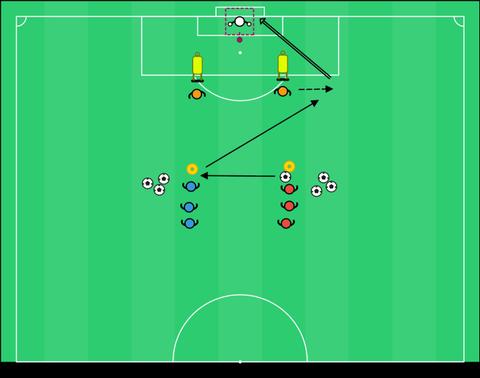
Finishing - attacker behind the defender
The situation starts from a side pass between two queues. A runner (orange) makes a diagonal break to the side of the defender and looks to shoot immediately after the first control. In the second variation, the attacker’s movement goes inside the defender.

4v3
The 4v3 situation starts when the coach calls “Watch out” or “Turn” for the midfielder (kk) to play to the attacker. Watch out = drop-off, then either dribbling forward or passing wide. Turn = free turn and decision-making; pass or dribble. If the drill is too easy, add a passing restriction before finishing.

Turn and shoot
The player stands with their back to goal around 11–14 metres away, with the passer in front. The passer plays a low pass, the player controls the ball to the side with their first touch and shoots with their second touch.

Shooting circuit
Three-point shooting circuit: (1) a powerful shot from around 20 metres, (2) shooting on the move from the passer’s lay-off from around 14 metres, and (3) a close-range shot or half-volley from short distance. After each shot, move quickly to the next station.

3v2 finishing
Three attackers start with the ball and drive towards two defenders. The aim is to create numerical superiority and finish. After scoring, the attackers receive a new ball and attack the opposite goal.

Passing and shooting
Player line 18–20 yards from goal, with the passer on the edge of the penalty area. The shooter passes to the passer and continues his run. The passer returns the ball one-touch into the shooter’s path. The shooter shoots directly or one-touch.

Back to goal — turn and finish
An attacker on the edge of the penalty area, back to goal. A defender is behind them. The server plays the ball to the attacker, who controls, turns away from the defender and finishes. Check the defender’s position over the shoulder. Depending on age group and ability, you can make it easier at first by having the defender keep their hands behind their back.
Defending

2v2 puolustukseen palaaminen
Kaksi sinistä hyökkää maaliin, jossa on maalivahti. Kaksi punaista puolustajaa lähtee merkeiltä hyökkääjien takaa. Alue on noin 20 × 24 metriä, ja vastakkaisessa päässä on kartioportti. Siniset lähtevät pallon kanssa kohti maalia, ja samalla hetkellä punaiset palautuvat. Lähempi puolustaja juoksee sisälinjaa pitkin pallon ja maalin väliin ja viivyttää pallollista. Toinen puolustaja palautuu jäljelle jäävän hyökkääjän ja maalin väliin sisäpuolelle. Kun tilanne on 2v2, puolustajat prässäävät ja varmistavat. Kuviossa punainen 1 ehtii sinisen 1 eteen ja viivyttää. Kun sininen syöttää laitaan, punainen 2 lähtee prässäämään syötön aikana ja punainen 1 putoaa varmistamaan. Punainen 2 riistää pallon, ja punaiset hyökkäävät heti porttiin. Nyt siniset palautuvat. Siniset saavat pisteen maalista, punaiset kuljettamalla pallon portin läpi. Mitä kauempaa puolustajat lähtevät, sitä vaikeampaa palautuminen on, joten säädä lähtömerkkien etäisyyttä tason mukaan. Vaihda roolit muutaman toiston jälkeen.

2v2 prässi ja läpimurto
Alue on noin 14 × 24 metriä, ja se jaetaan kolmeen osaan. Alimpana on 2v2-vyöhyke, keskellä läpimurtovyöhyke ja ylimpänä maalivahdin alue. Sen päätyrajalla on kaksi pikkumaalia. 2v2-vyöhykkeellä kaksi sinistä pitää palloa ja kaksi punaista prässää parina. Läpimurtovyöhykkeellä odottaa yksi sininen puolustaja. Punaisten tehtävä on riistää pallo. Toinen prässää pallollista, toinen varmistaa sisäpuolelta ja lukee seuraavan syötön. Riiston jälkeen punaiset lähtevät heti läpimurtoon: 2v1 sinistä puolustajaa vastaan ja viimeistely jompaankumpaan pikkumaaliin. Siniset 1 ja 2 eivät saa lähteä perään 2v2-vyöhykkeeltä, sininen 3 pysyy läpimurtovyöhykkeellä ja maalivahti omalla alueellaan. Kuviossa punainen 2 prässää syötön aikana, ja kun pallo palaa, roolit vaihtuvat. Kun sininen 1 yrittää kääntää pelin uudelleen, punainen 2 katkaisee syötön. Punainen 2 kuljettaa läpimurtovyöhykkeelle, vetää sinisen 3 itseensä ja syöttää punaiselle 1:lle, joka laukoo vasempaan pikkumaaliin. Vaihda rooleja muutaman toiston välein, niin jokainen pääsee prässäämään, puolustamaan läpimurtoa ja viimeistelemään. Sinisille voi antaa pisteen esimerkiksi viidestä peräkkäisestä syötöstä 2v2-vyöhykkeellä.

2v2 varmistuslinjalla
Kaksi paria pelaa 2v2:ta noin 16 × 24 metrin alueella. Kummassakin päässä on päätyraja ja kahdeksan metriä sen edessä varmistuslinja. Pari saa pisteen, kun se kuljettaa pallon vastustajan päätyrajan yli tai syöttää kaverille, joka ottaa sen haltuun rajan takana. Puolustavan parin toisen pelaajan on oltava omalla varmistuslinjallaan tai sen takana. Toinen prässää pallollista, toinen varmistaa. Kahdestaan palloon ei saa lähteä. Varmistaja saa nousta linjalta, kun hän katkaisee syötön tai riistää pallon prässääjän ohittaneelta hyökkääjältä. Silloin toinen puolustaja juoksee heti linjan taakse. Kuviossa punainen 1 prässää pallollista sisäpuolelta ja ohjaa hänet laitaan. Punainen 2 on linjalla vinosti hänen takanaan. Kun sininen syöttää toiselle puolelle, punainen 1 siirtyy prässäämään uutta pallollista jo pallon kulkiessa, ja punainen 2 liukuu linjaa pitkin pysyäkseen hänen takanaan. Pari liikkuu yhdessä. Sininen 1 lähtee juoksuun prässääjän selän taakse, mutta punainen 2 lukee syötön ja katkaisee sen. Riiston jälkeen punaiset hyökkäävät heti sinisten päätyrajalle. Lähin sininen prässää, ja toinen juoksee oman varmistuslinjansa taakse. Nyt siniset puolustavat samalla tavalla. Kun sininen 1 riistää pallon laidalla, punaisista vain punainen 2 ehtii takaisin linjalle. Siniset pelaavat 2v1:n. Sininen 1 vetää punaisen 2 itseensä ja syöttää juoksuun sinisen 2:lle, joka kuljettaa pallon päätyrajan yli. Pelaa 1–2 minuutin jaksoja. Jos pelaajia on enemmän kuin neljä, tee useampi kenttä rinnakkain tai vaihda paria jakson välein.

2v2/3v3 small goals
2v2 or 3v3 small-sided game with small goals and no goalkeeper. When a team loses the ball, they switch immediately to defending: the first defender presses the player on the ball, the second covers, and the third balances.
Small-sided games

End-zone game, target players in the end zones
Six players in three pairs in a clear area. No goals. - One pair are target players. - One pair in each end zone, and they move only along their own end line. - The other two pairs play 2v2 in the middle. A point is scored when the ball is dribbled from one end zone to the other, i.e. from one target player to the other. After a successful pass, the same team continues with the ball in the opposite direction. The defending pair tries to close the passing lane to the target player and win the ball. After winning the ball, the pair that wins it can attack either end zone, but the point always requires the full journey: the ball must be passed from one target player to the other. In practice, the winning pair starts from the nearest end zone. - 3 minutes at a time, then pairs swap positions.

End-zone game with changing direction
4v4 with an empty zone, with an end zone marked by cones at both ends. No goals. A point is scored when a player from your own team receives a pass in the end zone. The coach calls a change of direction during play, and the attacking direction turns from that moment. The defending team has just compacted towards the wrong end, so the space is behind them; this must be seen and used before they have time to turn. Playing time 3–4 minutes at a time, with several calls per block.

3v3 line game
3v3 game with no goals. A goal is scored when a team manages to stop the ball behind the opponent’s end line. The receiver must get the ball under control behind the line; simply kicking the ball over the line is not enough. Teaches attacking and defending in the depth (behind the line).
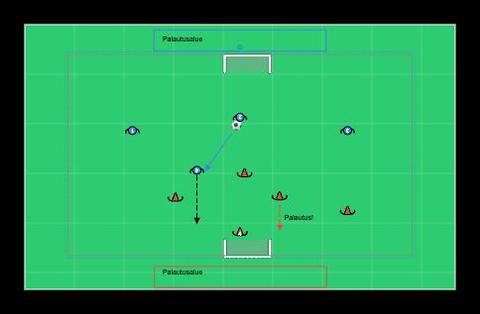
4v4 recovery zone game
4v4 game with two goals. Each team has its own "recovery zone" behind the goal. When a team loses possession, one player must go into the recovery zone before they can take part in defending. This creates a temporary numerical superiority for the attacking team and forces a quick transition.
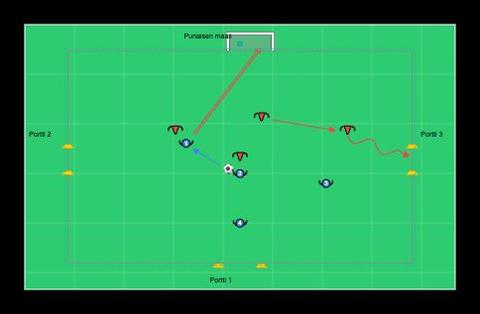
4v4 three goals
4v4 game where one team has one normal goal and the other has three small cone goals on different sides of the pitch. The one-goal team attacks directly, the three-goal team looks for the open goal. Roles change regularly.
Possession and transitions
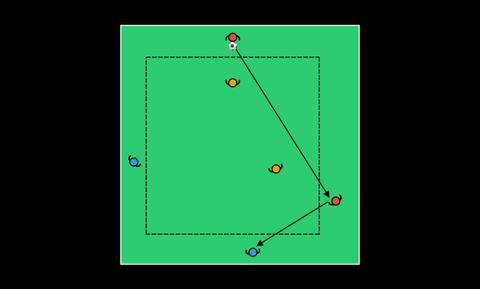
4v2 rondo
Mark out a square area and create three pairs of two players. Two pairs stay on the outside along the edges, so there are four passers (one on each side). One pair works inside the area, winning the ball. The outside pairs keep the ball moving from side to side. The defenders split the work: one player presses the player on the ball, while the other closes off the next passing lane. When winning the ball is successful, the pairs swap roles and the game continues immediately without a new start. Adjust the size of the square to the level. A smaller square shortens the passing distances and forces quicker first touch.

Continuous 2v1/3v1 possession game on two sides
One player (red in the picture, wearing a bib) is the winner/defender who wins the ball. In the middle of the area there is a “gate” through which the players on the ball (3 blue players in the picture) try to play from one side to the other in different ways. The game is always continuous, e.g. 1 minute at a time, and the winner/defender changes. Variation 1: The player on the ball must dribble through the gate to get from one side to the other, then immediately on that side there is a new 2v1 back again. Variation 2: The players on the ball must always play through the gate with passing to a third player, at which point the player who passed moves to that side to support. Variation 3: The players on the ball must always play through the gate with passing to a third player, at which point the player who DID NOT pass moves to that side to support.

Three-zone possession drill (basic)
Three teams, one per zone (30×15 m divided into three 10×15 m areas). The teams in the end zones keep possession and try to pass to the other end zone. The middle team sends 2 players to win the ball in the end zone and 1 stays in the middle to intercept passes between the zones. When the ball is won or goes out, the team that lost possession moves into the middle. A point is scored when the ball is played successfully from end to end.
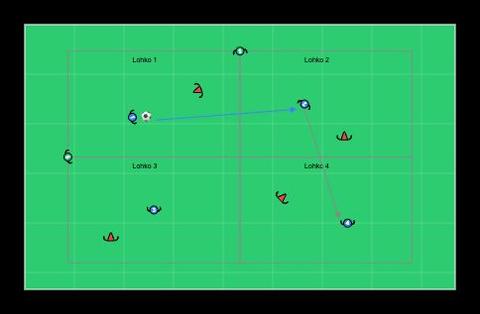
Possession square
A square-shaped area divided into four zones. Two teams (e.g. 4v4+2 jokers). The team in possession keeps the ball and tries to play into as many zones as possible. A point for each new zone the ball is played into in succession. The jokers always play with the team in possession.
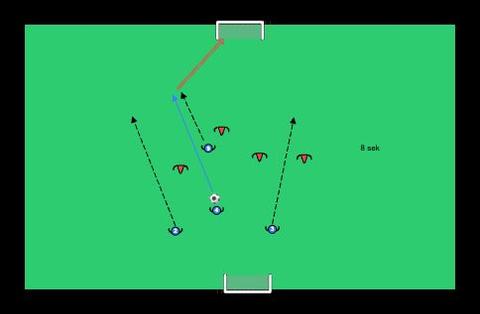
Counter-attack game
The defending team defends their own goal. When they win the ball, they have 8 seconds to attack the opposite goal. If a goal is scored within the time limit, the point counts double. The attacking team continues normal play. A quick transition from defending to attacking is decisive.

Possession to goal
Team game (e.g. 5v5+GK) on a half pitch. The team in possession keeps the ball and tries to attack the goal. Before attacking the goal, at least 5 consecutive passes are required. The defending team tries to win the ball and play a counter-attack to the other end.

Numerical superiority possession game with jokers
Possession game (e.g. 4v2) with two jokers, who always play on the side of the player on the ball. The jokers move along the edges of the area and offer extra passing options. 1-2 touch limit for the outside players, jokers on free touches. The defenders try to win the ball — the player who made the last pass goes into the middle.

Zonal rondo
Three zones next to each other (narrow-wide-narrow). The team in possession starts in the middle zone and tries to play the ball to the wide zone. The defenders try to stop the ball being played wide. After a successful pass wide, the ball is played back into the middle and switched to the other side.

Counter-pressing game
Two teams play a possession game in a limited area. When a team loses possession, they have 5 seconds to win the ball back with counter-pressing. If the ball-winning is successful, play continues. If not, the team that lost possession does a penalty task. Objective: immediate reaction to loss of possession.

4v4 transition game
4v4 game with two goals (+GK). When the ball goes out of bounds or a goal is scored, the coach passes a new ball onto the pitch to a random team. A continuous transition situation: the teams never know who will get the next ball. Forces constant readiness for both attacking and defending.